
How to Abstract the Landscape: From Real to Expressive Painting

In the west of Wales lies a misty, deeply etched series of valleys where time seems to stand still, the seasons exist in unison and the sky has never felt so big, so high.
It’s a place where I spent many weeks over the last few years, at a turning point in my life, where several seams were splitting, and others were being sewn together like the frayed, rough edges of the England wales border. the landscape was my constant companion, my safe space in solitude, and my biggest motivator. This is the story of the marks those landscapes left on me.
From the dappled light forcing its way through yellow-green clouds to the rust red dried bracken and violet heather, this land floods the senses in a way nowhere else has. This was all the spark I needed to start painting and abstracting the landscape.
But what is an abstract landscape, and how do you create an abstract landscape painting?
What is an abstract landscape?
An abstract landscape, to me, is not a completely unrecognisable form on a canvas. An abstract landscape explores the feeling, the light, the texture and the "sense of place". It's not about creating an accurate or realistic drawing or painting of the scene in front of you, but it's how it makes you feel. What do you notice? What do you feel?

How to paint an abstract landscape
The first step does not involve paint, or paper, or a sketchbook. First you need to look. Not through a smartphone or an Instagram reel, but be physically present in the landscape. What do you notice? What starts to recede into the distance? Are you instantly attracted to the pattern the cloud shadows make across the grass? Do you see patterns in the flowerbeds you hadn't noticed before.
Spend time in the places you love, and ask yourself what you notice.
Then ask yourself why. Why do you notice those things? What is it about this particular landscape that pulls you in?
Take notes. Describe the scene with feelings, senses, metaphors. Break it down into colour, contrast, shapes, lines. Write down what you see and you might start to see these same ideas emerge when you're in another space.
Only after a lot of observing would I suggest you do some loose, expressive sketches.
Through careful, intentional observation, I discovered a love of high horizon lines, with landscapes emerging from the undergrowth and pushing back into dramatic mountains or quiet open spaces. Like a child peeking through the long grass during a game of hide and seek, my paintings peek through into wider open worlds, where one can retreat undisturbed and without judgement.

Start with your reference, then let go
It is extremely difficult to paint abstractly, and this is often because people start painting without an idea, or a focus. No matter how abstract the work, it still needs something. A reason: dynamic movement of paint like Jackson Pollock, careful geometry of Piet Mondrian. For an sbtracted landscape, you could start with a squiggly line to suggest a horizon, then, push away from your reference photos, what you know. Steer away from realistic colours or proportions, and try to paint the landscape the way it feels, not the way it looks.
Explore mark making
My latest collection of abstract landscapes is called "Land Marks" and is where I am playing and exploring with mark-making more than in previous collections. Mark making can mean holding your brushes differently, experimenting with larger brushes, using dry media like chalk or pencil on top of paint, stenciling, sanding, scratching. Mark making allows you to add your unique expression to your painting as only you have your particular collection of mark making tools and preferences. For me, I love some bright blue linework to emphasise a tree line, and some splashes of a bold, unexpected colour where it shouldn't be. Mark making is your chance to get creative and let go, even if you started with pretty much a realistic landscape painting.
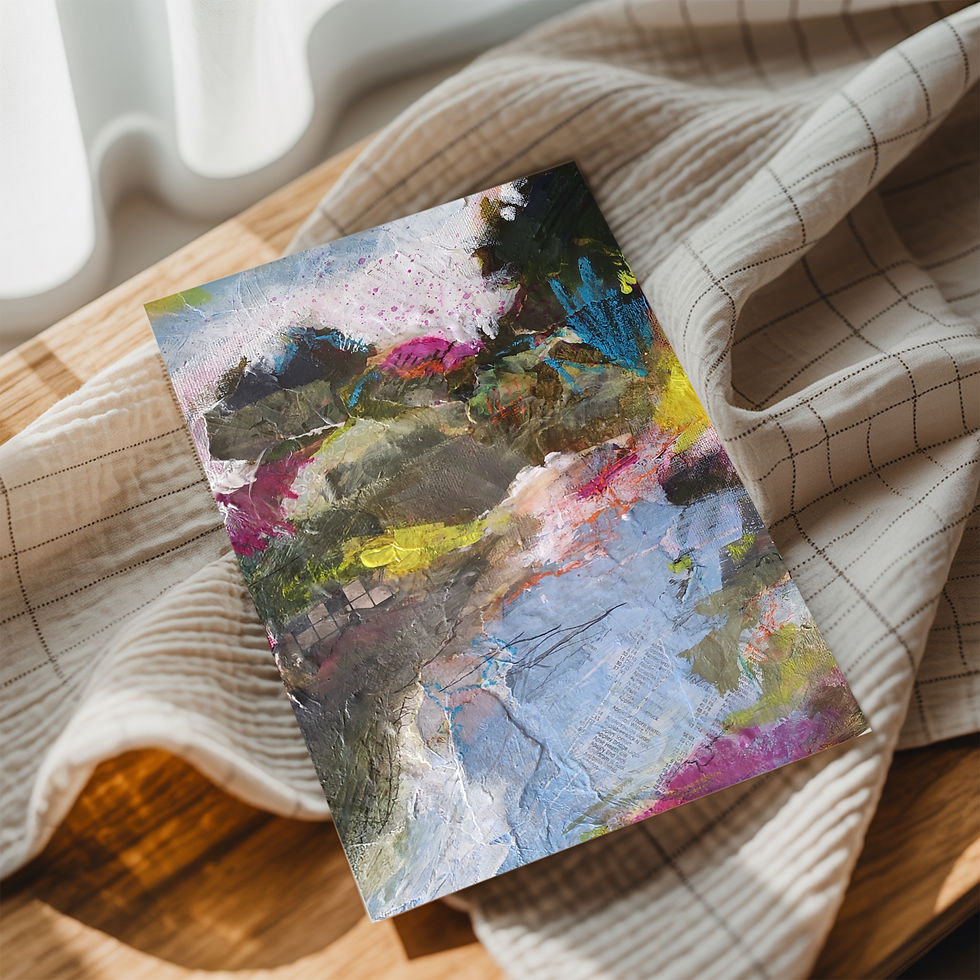
Paint the landscape how it feels, not how it looks
“The more I know of one spot, the more I find to paint” said Joan Eardley.
My time in Wales has changed me as an artist. I've developed a deeper understanding of what inspires me. I find myself seeking out the long grass hidden under a vast sky, the windswept hills and valleys streaked in yellow ochre and red.
I'll be talking more about abstract landscape art and my "Land Marks" collection in future posts, so make sure you're tuned in to my website, and sign up for Studio Notes to get early access to new collections, sales, workshops and more.


Comments